
How Talarion Helps
When AI doesn't know the right questions to ask, it can produce responses predicated on fundamental misapprehensions. With Talarion, LLMs see huge improvements along two axes: correctness and context efficiency.
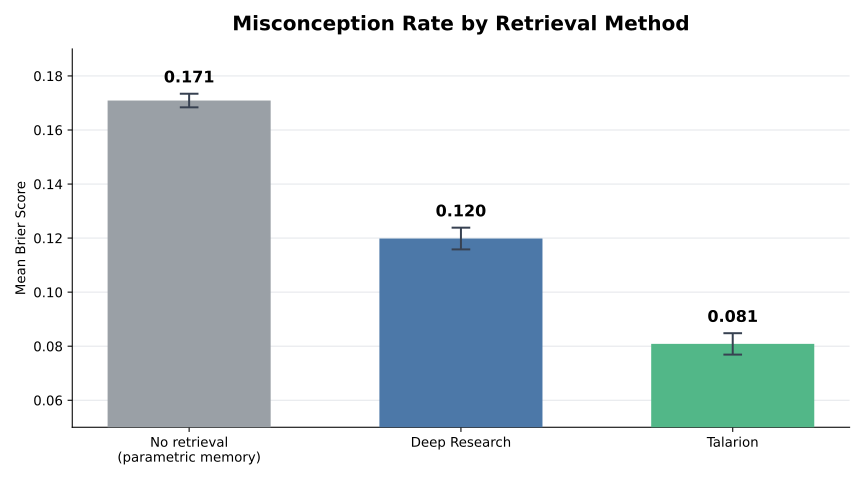
Mean Brier score (lower is better) by information retrieval method across all 100 research questions (1,961 evaluation questions). Error bars show ± 1 standard deviation. All responses were produced using gpt-5.4 and all web search was performed using Exa across 3 turns of search, with 2 queries per turn and 10 results per query for a total of up to 60 unique sources.
Introducing PriorBench
To evaluate a search API, you can look for needles in haystacks: take a set of questions, produce an authoritative answer key, and you're off to the races. Evaluating Talarion is harder. That's because we don't answer the questions you knew to ask, we answer the questions you didn't.
To prove that Talarion is helping your LLM at inference time, we need to prove that your LLM is — somehow — better informed to answer the question you asked it. If the question you asked was a pure search question, then there isn't much to do. If you want to know how tall the Burj Khalifa is, you're not worried about unknown unknowns. If, on the other hand, you want to understand the hottest real estate investment opportunities in the UAE, you most certainly are.
That's why PriorBench begins with a handcrafted set of N = 100 research questions requiring expert judgement in synthesizing world state. We ask questions like “is open source AI catching up to closed source models” and “how are Chinese domestic policy priorities evolving?”
For each research question, we identify the 5-30 binary assertions about the world (as of the evaluation date) that would prove most important to an expert making an informed judgement. Examples might include “Did Alibaba release Qwen3-Omni as an open-weight omni-modal model?” [Yes] and “Did China repeal its Personal Information Protection Law (PIPL)?” [No]. These binary questions constitute the evaluation set. All binary assertions are chosen specifically to target developments between the candidate model's knowledge cutoff and the evaluation date. The candidate model is then used as a judgemental forecaster over the evaluation set, allowing for rich error quantification.
PriorBench was designed to quantify the credibility of LLM responses to challenging, open-ended questions without objective answers. We do that by checking how many incorrect priors the LLM was laboring under at inference time. Having an accurate and up-to-date understanding of world state isn't a sufficient condition for superintelligence, but it's definitely a necessary one. And that's exactly the problem that Talarion was designed to solve.
Download PriorBench Questions
If you'd like to dive deeper into what exactly PriorBench is measuring (and how) we've made the entire evaluation set public: 100 Research Questions and their constituent 1,961 binary Evaluation Questions, each with a true/false label and source citations, resolved as of December 1, 2025.
Example Omissions
- User query“What's going to happen to B2B SaaS companies over the next six months and why?”LLM failed to findThe January 2026 launch of Anthropic's Claude Cowork as the specific catalyst for the sector repricing.
- User query“Where should I look to source precision manufactured steel for a Texas industrial plant?”LLM failed to findThe April 2026 Section 232 tariff update that raised the baseline duty on imported steel to 50%, which significantly alters the economics of domestic sourcing.
- User query“I'm planning a US national parks roadtrip. What should I watch out for?”LLM failed to findThe January 1, 2026 introduction of a $100 per-person non-resident surcharge at 11 marquee parks and the new $250 non-resident annual pass.
- User query“Should I go to college for a CS degree?”LLM failed to findThe February 2026 New York Fed analysis showing a 7% unemployment rate and 19% underemployment rate for recent CS grads.
Four example questions for which Talarion surfaced at least one material omission. These examples were adapted from production.
Interested in learning more? Reach out to contact@talarion.tech for methodological details.
© 2026 Talarion, Inc.